International Balkan University Hosts Necmeddin Bilal Erdogan

International Balkan University hosted Necmeddin Bilal Erdogan, President of the Board of Trustees of the Ilim Yayma Foundation, for the talk “Building the New World: Academic and Cultural Bridges for Balkan Youth.”Meeting with our students, Erdogan emphasized that support for Balkan youth and International Balkan University will continue to grow in the coming period. The program was moderated by our Rector, Prof. Dr. Lütfi Sunar, and organized with the support of Presidency for Turks Abroad ... Read more...

Genocide, International Justice, and State Responsibility: The Legacy of Alija Izetbegovic and the Future of Bosnia and Herzegovina Three Decades After the Dayton Agreement

The aim of the conference is to critically examine the legal, political, and historical legacies of Alija Izetbegovic in the context of post-conflict Bosnia and Herzegovina, with particular focus on the implications of the Dayton Peace Agreement, the adjudication of genocide and international crimes, and the challenges of state responsibility under international law. The Conference will be organized in a hybrid format, allowing for onsite and online participation. Read more...

Genocide, International Justice, and State Responsibility: The Legacy of Alija Izetbegovic and the Future of Bosnia and Herzegovina Three Decades After the Dayton Agreement.”

The aim of the conference is to critically examine the legal, political, and historical legacies of Alija Izetbegovic in the context of post-conflict Bosnia and Herzegovina, with particular focus on the implications of the Dayton Peace Agreement, the adjudication of genocide and international crimes, and the challenges of state responsibility under international law. The Conference will be organized in a hybrid format, allowing for onsite and online participation. This event will take pl... Read more...

At the Crossroads of Multipolarization: The Western Balkans in a Fragmented Global Order

This conference aims to explore the complex implications of global multipolarity for the Balkan region. As global power becomes increasingly diffused across multiple centers - including the United States, European Union, China, Russia, Türkiye, and others - the Western Balkans find themselves navigating a competitive geopolitical space. The conference seeks to examine how multipolarity influences regional diplomacy, foreign policy alignment, governance, security, identity politics, and econom... Read more...

Geopolitics, Diplomacy, and Legal Framework for Regional Cooperation in Balkans

BU Hosts Mr. Mevlüt Çavusoglu for a Distinguished Panel on Regional Cooperation -In a landmark academic and diplomatic event, the International Balkan University (IBU) proudly hosted Mr. Mevlüt Çavusoglu, Member of the Turkish Parliament and former Minister of Foreign Affairs of the Republic of Türkiye, for a high-level panel discussion titled “Geopolitics, Diplomacy, and Legal Frameworks for Regional Cooperation in the Balkans.”The event brought together a diverse and influential audience, i... Read more...

Bridging the Digital Divide: AI and Digitalization for inclusive development

Panel discussion on “Bridging the Digital Divide: AI and Digitalization for inclusive development”The Balkan Research Center organized a panel discussion with the participation of the Minister for Digital Transformation of North Macedonia, Mr. Stefan Andonov as a keynote speaker for the panel.The Minister of Digital Transformation, Mr. Stefan Andonov, pointed out the efforts of the government in integrating and utilizing artifical intelligence in the digitalization of North Macedonia.Rector o... Read more...

Analysis

Politics
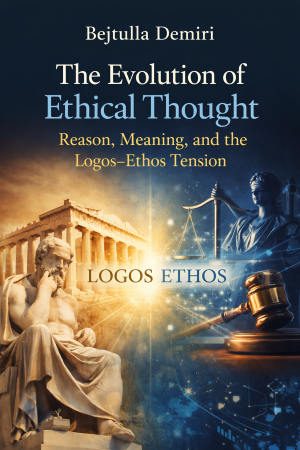
The Evolution of Ethical Thought: Reason, Meaning, and the Logos–Ethos Tension

The Evolution of Ethical Thought: Reason, Meaning, and the Logos–Ethos Tension

Author:Prof. Dr. Bejtulla Demiri 

In “The Evolution of Ethical Thought: Reason, Meaning, and the Logos–Ethos Tension,” Bejtulla Demiri analyzes the historical development of ethics as a continuous attempt to reconcile the tension between logos (rational understanding of reality) and ethos (the normative search for meaning, value, and dignity). Ethics, according to the author, emerges precisely at the intersection of these two dimensions, where rational knowledge seeks moral orientation.

Demiri begins with classical Greek philosophy, where ethics was grounded in a rational and meaningful cosmic order. Moral life was understood as living in harmony with nature and reason, and virtue represented participation in an objective metaphysical structure. In this classical synthesis, truth and goodness were inseparable, and ethical excellence was aligned with the rational order of the universe.

This unity gradually disintegrated as historical experience weakened confidence in a coherent cosmos. Ethics shifted from public virtue toward individual stability and inner tranquility, while logos itself was reduced to instrumental rationality focused on efficiency and control. As a result, the link between rational knowledge and ethical meaning was weakened.

In response, many societies developed theonomous ethical systems, grounding morality in divine authority rather than human reason or nature. Ethics became a matter of obedience to transcendent command, offering moral clarity and existential security but limiting human autonomy by locating moral authority outside the individual.

The modern era introduced a decisive break by relocating moral authority within the human subject. Ethics was reconceived as autonomy rather than obedience, culminating in deontological ethics, where moral action is determined by rational duty and universalizable principles. While this framework emphasized freedom and self-legislation, Demiri argues that it produced an abstract and existentially thin conception of morality, detached from lived experience, emotion, and social context.

Post-modern ethical thought reacted against this abstraction by questioning the very foundations of morality. Some approaches sought to reintroduce values, emotions, and lived experience, while others critically exposed moral systems as historically contingent constructions shaped by power, fear, and social regulation.

Demiri concludes that contemporary ethics exists without a universally accepted foundation. Neither cosmic order, divine command, rational autonomy, nor objective values can claim absolute authority. Ethics thus becomes an open, reflective practice rather than a closed system—a continuous human dialogue aimed at orienting freedom toward dignity and responsibility in a morally plural and uncertain world.

Politics
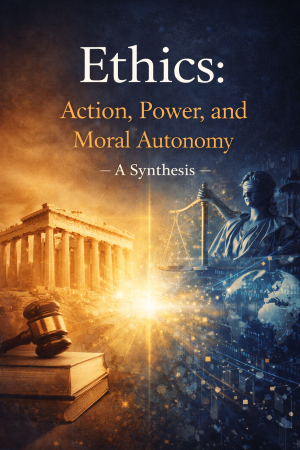
Ethics: Action, Power, and Moral Autonomy — A Synthesis

Ethics: Action, Power, and Moral Autonomy — A Synthesis

Ethics is presented as a fundamental human response to vulnerability, uncertainty, and the absence of predetermined meaning. Human beings are not born with a ready-made moral order; instead, moral life emerges from the need to orient action and responsibility in a world that does not provide clear instructions. Ethics is therefore not an external system imposed on humanity, but a creative and reflective practice through which meaning and normativity are constructed.

The development of ethical life is traced as a movement from fear toward autonomy. In its earliest forms, moral orientation arose from vulnerability in the face of an unpredictable world. Norms were shaped by fear, mystery, and obedience to external forces believed to govern reality. Moral life at this stage was heteronomous, grounded in submission rather than understanding.

As societies became more structured, these early orientations were transformed into organized systems of authority. Moral norms were preserved through ritual and hierarchy, often serving power and stability rather than human dignity. Mystery was no longer merely experienced but strategically maintained, reinforcing compliance and limiting critical reflection.

A crucial transition occurs when imagination and narrative begin to humanize reality. Through symbolic meaning and storytelling, fear loosens its grip, and the world becomes interpretable rather than merely threatening. This transformation prepares the ground for critique and reflection, enabling individuals to question inherited norms.

Ethics reaches a decisive stage with the emergence of rational reflection. Moral authority shifts from obedience to justification, and norms must be defended through reasons rather than tradition or fear. Moral autonomy arises as individuals become capable of legislating obligations for themselves through shared rational standards.

However, ethical principles remain empty unless embodied in concrete persons. Moral life is rooted in personality—the reflective capacity to judge, take responsibility, and correct oneself. Ethical action is sustained by care for others and accountability to oneself, transforming freedom into responsibility.

Ethics is realized through praxis, the unity of thought and action. Work, cooperation, and social life become moral when guided by responsibility rather than mere efficiency. Yet modern technological and economic systems threaten ethical life by replacing moral judgment with functional necessity, hollowing out responsibility without overt coercion.

Justice functions as the bridge between personal conscience and collective order. Power becomes legitimate only when exercised as trust and directed toward the common good. The ultimate ethical horizon is the unity of virtue and happiness, understood not as pleasure but as human flourishing achieved through meaningful and responsible action.

Ethics remains an open process rather than a closed system. It is a continuous effort to transform vulnerability into freedom and to shape a form of life worthy of human dignity in an uncertain and interconnected world. Author: Prof. Dr. Bejtulla Demiri

Politics
Akhlaq and the Path from Fitra to Flourishing

Akhlaq and the Path from Fitra to Flourishing

The text explains Islamic ethics (Akhlaq) as a complete moral system that helps humans move from their innate moral nature (fitra) toward true human flourishing (sa?ada). It argues that morality is not just a set of rules, but a dynamic process that combines reason, conscience, intention, and divine guidance.

Human beings are naturally incomplete and vulnerable, but this weakness pushes them to create meaning, values, and moral responsibility. Over history, humans moved from fear-based explanations of the world (mystery and power) toward moral autonomy and reason, with Islam grounding ethics in the natural moral compass of fitra rather than fear or coercion.

At the center of ethics is the moral personality, where freedom becomes responsibility. Key ethical elements include:

Niyyah (sincere intention),

Taqwa (moral awareness),

Taklif (freedom with accountability),

Conscience, rooted in love and human dignity.

Ethics must also be lived in the world. Humans are stewards (khalifa) entrusted with the world (amanah), responsible for justice, compassion, and care. Moral action turns values into reality and aims at the Highest Good, where personal, social, and spiritual well-being come together.

Justice is the foundation of social life, linking individual conscience with public institutions. The text distinguishes legitimate authority (based on trust and justice) from mere power (based on force). True happiness comes from virtue, not pleasure, through lifelong self-purification (tazkiyat al-nafs).

Overall, Akhlaq is presented as a living moral framework that unites inner character and social justice, offering guidance for modern global challenges and encouraging humans to become responsible moral builders of the world. Author: Prof. Dr. Bejtulla Demiri

Politics
WEF Global Risks Report 2026

WEF Global Risks Report 2026

The Global Risks Report 2026 presents a comprehensive assessment of the most severe global risks facing the world across three time horizons: the present (2026), the short to medium term (to 2028), and the long term (to 2036). Based on insights from over 1,300 global leaders and experts through the Global Risks Perception Survey (GRPS), the report argues that the world has entered a new phase defined by intensified competition, weakened multilateralism, and compounding systemic risks. This is a summary of the WEF Global Risks Report 2026 

Society
Digital Inheritance and Virtual Assets in the Republic of North Macedonia: Normative Challenges and the Need for Modernization of the Legal Framework

Digital Inheritance and Virtual Assets in the Republic of North Macedonia: Normative Challenges and the Need for Modernization of the Legal Framework

The digital transformation has created new forms of property with legal and economic value, which are also becoming increasingly important in inheritance relations. The category of digital assets includes crypto-assets, monetized electronic accounts, domains, licenses to use cloud services, as well as digital content with financial or personal value.

In many legal systems, these assets pose particular challenges due to the lack of direct regulation, the conflict between the right of heirs and the right to privacy, and the impact of contractual terms of digital platforms on the practical realization of inheritance. In the Republic of North Macedonia, the existing framework in inheritance law, obligations and personal data protection still does not provide clear solutions for the identification, valuation and transfer of digital assets after death.

   The paper addresses the legal nature of digital assets, practical and normative difficulties, and proposes directions for legislative modernization, including explicit recognition of digital heritage, asset categorization, and standardized procedures for heir access, drawing on European examples of regulation and case law. 

Politics
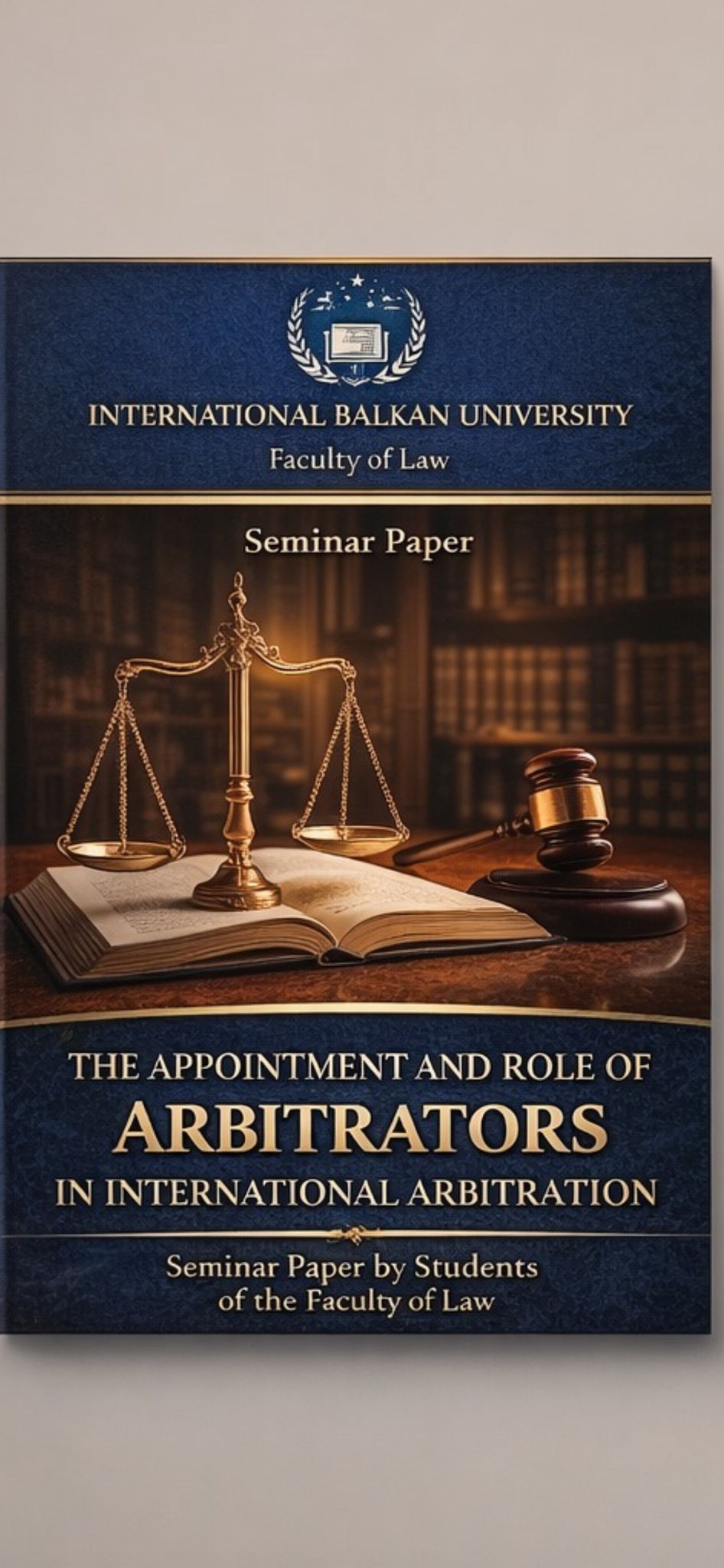
The Appointment and Role of Arbitrators in International Arbitration

The Appointment and Role of Arbitrators in International Arbitration


This paper explores how the arbitrators are chosen and the role they have in international arbitration, focusing on how their selection, qualifications, and ethical obligations affect the fairness and legitimacy of the arbitration procedure. Because arbitration is dependent on party autonomy and neutrality, the choice of arbitrator really important because based on who you choose it will affect the decision. The study explores the main methods of appointing arbitrators—such as party agreement, institutional appointment, and appointments made by courts or what happens when disputing parties fail to choose an arbitrator. It also analyzes the most important qualities of the arbitrators that affect the process and they must possess, including independence, impartiality, expertise, and professional integrity. Furthermore, the paper discusses the procedures for challenging, removing, or replacing arbitrators, with reference to the rules of the ICC, LCIA, and UNCITRAL. The ethical part of arbitrators’ work, particularly issues of neutrality, conflicts of interest, diligence, and confidentiality, is examined in light of internationally accepted standards. Through a comparative review of leading institutional rules and relevant academic literature, the paper highlights the central role arbitrators play in ensuring due process and maintaining confidence in international arbitration.


News

Politics
12-day Israel-Iran war

12-day Israel-Iran war opened Pandora's box: What comes next?

Though seemingly concluded by a Trump-brokered cease-fire, the 12-day Iran-Israel war has likely opened the door to a prolonged...

Society
Global implications of the U.S. attack on Iran

Global implications of the U.S. attack on Iran

Despite growing claims of a multipolar world, the U.S. remains the sole hegemon as Europe bandwagons, Russia remains indifferent, an...

Politics
Israel's violation of international law

Israel's violation of international law: Attack on aid ship Madleen

The seizure of a humanitarian aid ship carrying civilians exposes not only Israel's ongoing blockade of Gaza, but also its...

Society
Regional security challenges

Regional Security Challenges in the Western Balkans

An analysis of emerging security threats and the role of international cooperation in maintaining stability across the region...

Economy
Economic diplomacy

Economic Diplomacy and Trade Relations in Southeast Europe

Examining the intersection of economic policy and diplomatic relations, and how trade partnerships shape regional politics...

Politics
Democratic institutions

Strengthening Democratic Institutions in Post-Conflict Societies

The challenges and opportunities for building robust democratic frameworks in societies transitioning from conflict to peace...

Document