

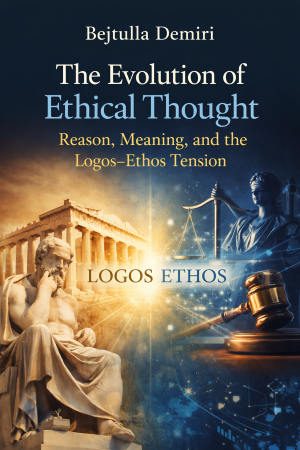
Author:Prof. Dr. Bejtulla Demiri
In “The Evolution of Ethical Thought: Reason, Meaning, and the Logos–Ethos Tension,” Bejtulla Demiri analyzes the historical development of ethics as a continuous attempt to reconcile the tension between logos (rational understanding of reality) and ethos (the normative search for meaning, value, and dignity). Ethics, according to the author, emerges precisely at the intersection of these two dimensions, where rational knowledge seeks moral orientation.
Demiri begins with classical Greek philosophy, where ethics was grounded in a rational and meaningful cosmic order. Moral life was understood as living in harmony with nature and reason, and virtue represented participation in an objective metaphysical structure. In this classical synthesis, truth and goodness were inseparable, and ethical excellence was aligned with the rational order of the universe.
This unity gradually disintegrated as historical experience weakened confidence in a coherent cosmos. Ethics shifted from public virtue toward individual stability and inner tranquility, while logos itself was reduced to instrumental rationality focused on efficiency and control. As a result, the link between rational knowledge and ethical meaning was weakened.
In response, many societies developed theonomous ethical systems, grounding morality in divine authority rather than human reason or nature. Ethics became a matter of obedience to transcendent command, offering moral clarity and existential security but limiting human autonomy by locating moral authority outside the individual.
The modern era introduced a decisive break by relocating moral authority within the human subject. Ethics was reconceived as autonomy rather than obedience, culminating in deontological ethics, where moral action is determined by rational duty and universalizable principles. While this framework emphasized freedom and self-legislation, Demiri argues that it produced an abstract and existentially thin conception of morality, detached from lived experience, emotion, and social context.
Post-modern ethical thought reacted against this abstraction by questioning the very foundations of morality. Some approaches sought to reintroduce values, emotions, and lived experience, while others critically exposed moral systems as historically contingent constructions shaped by power, fear, and social regulation.
Demiri concludes that contemporary ethics exists without a universally accepted foundation. Neither cosmic order, divine command, rational autonomy, nor objective values can claim absolute authority. Ethics thus becomes an open, reflective practice rather than a closed system—a continuous human dialogue aimed at orienting freedom toward dignity and responsibility in a morally plural and uncertain world.