

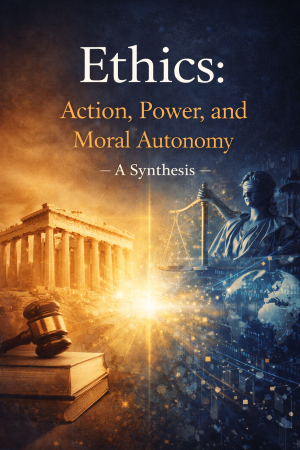
Ethics is presented as a fundamental human response to vulnerability, uncertainty, and the absence of predetermined meaning. Human beings are not born with a ready-made moral order; instead, moral life emerges from the need to orient action and responsibility in a world that does not provide clear instructions. Ethics is therefore not an external system imposed on humanity, but a creative and reflective practice through which meaning and normativity are constructed.
The development of ethical life is traced as a movement from fear toward autonomy. In its earliest forms, moral orientation arose from vulnerability in the face of an unpredictable world. Norms were shaped by fear, mystery, and obedience to external forces believed to govern reality. Moral life at this stage was heteronomous, grounded in submission rather than understanding.
As societies became more structured, these early orientations were transformed into organized systems of authority. Moral norms were preserved through ritual and hierarchy, often serving power and stability rather than human dignity. Mystery was no longer merely experienced but strategically maintained, reinforcing compliance and limiting critical reflection.
A crucial transition occurs when imagination and narrative begin to humanize reality. Through symbolic meaning and storytelling, fear loosens its grip, and the world becomes interpretable rather than merely threatening. This transformation prepares the ground for critique and reflection, enabling individuals to question inherited norms.
Ethics reaches a decisive stage with the emergence of rational reflection. Moral authority shifts from obedience to justification, and norms must be defended through reasons rather than tradition or fear. Moral autonomy arises as individuals become capable of legislating obligations for themselves through shared rational standards.
However, ethical principles remain empty unless embodied in concrete persons. Moral life is rooted in personality—the reflective capacity to judge, take responsibility, and correct oneself. Ethical action is sustained by care for others and accountability to oneself, transforming freedom into responsibility.
Ethics is realized through praxis, the unity of thought and action. Work, cooperation, and social life become moral when guided by responsibility rather than mere efficiency. Yet modern technological and economic systems threaten ethical life by replacing moral judgment with functional necessity, hollowing out responsibility without overt coercion.
Justice functions as the bridge between personal conscience and collective order. Power becomes legitimate only when exercised as trust and directed toward the common good. The ultimate ethical horizon is the unity of virtue and happiness, understood not as pleasure but as human flourishing achieved through meaningful and responsible action.
Ethics remains an open process rather than a closed system. It is a continuous effort to transform vulnerability into freedom and to shape a form of life worthy of human dignity in an uncertain and interconnected world. Author: Prof. Dr. Bejtulla Demiri