
Genocide, International Justice, and State Responsibility: The Legacy of Alija Izetbegovic and the Future of Bosnia and Herzegovina Three Decades After the Dayton Agreement

The aim of the conference is to critically examine the legal, political, and historical legacies of Alija Izetbegovic in the context of post-conflict Bosnia and Herzegovina, with particular focus on the implications of the Dayton Peace Agreement, the adjudication of genocide and international crimes, and the challenges of state responsibility under international law. The Conference will be organized in a hybrid format, allowing for onsite and online participation. Read more...

Genocide, International Justice, and State Responsibility: The Legacy of Alija Izetbegovic and the Future of Bosnia and Herzegovina Three Decades After the Dayton Agreement.”

The aim of the conference is to critically examine the legal, political, and historical legacies of Alija Izetbegovic in the context of post-conflict Bosnia and Herzegovina, with particular focus on the implications of the Dayton Peace Agreement, the adjudication of genocide and international crimes, and the challenges of state responsibility under international law. The Conference will be organized in a hybrid format, allowing for onsite and online participation. This event will take pl... Read more...

At the Crossroads of Multipolarization: The Western Balkans in a Fragmented Global Order

This conference aims to explore the complex implications of global multipolarity for the Balkan region. As global power becomes increasingly diffused across multiple centers - including the United States, European Union, China, Russia, Türkiye, and others - the Western Balkans find themselves navigating a competitive geopolitical space. The conference seeks to examine how multipolarity influences regional diplomacy, foreign policy alignment, governance, security, identity politics, and econom... Read more...

Geopolitics, Diplomacy, and Legal Framework for Regional Cooperation in Balkans

BU Hosts Mr. Mevlüt Çavusoglu for a Distinguished Panel on Regional Cooperation -In a landmark academic and diplomatic event, the International Balkan University (IBU) proudly hosted Mr. Mevlüt Çavusoglu, Member of the Turkish Parliament and former Minister of Foreign Affairs of the Republic of Türkiye, for a high-level panel discussion titled “Geopolitics, Diplomacy, and Legal Frameworks for Regional Cooperation in the Balkans.”The event brought together a diverse and influential audience, i... Read more...

Bridging the Digital Divide: AI and Digitalization for inclusive development

Panel discussion on “Bridging the Digital Divide: AI and Digitalization for inclusive development”The Balkan Research Center organized a panel discussion with the participation of the Minister for Digital Transformation of North Macedonia, Mr. Stefan Andonov as a keynote speaker for the panel.The Minister of Digital Transformation, Mr. Stefan Andonov, pointed out the efforts of the government in integrating and utilizing artifical intelligence in the digitalization of North Macedonia.Rector o... Read more...

Building Resilience, Fostering Belonging: Psychological Strategies for First-Year International Students.”

International Balkan University’s (IBU) Balkan Research Center (BRC) hosted an insightful workshop organized by Asst. Prof. Dr. Flamur Ismaili, titled “Building Resilience, Fostering Belonging: Psychological Strategies for First-Year International Students.” The event featured a comprehensive presentation by Prof. Dr. Musa Musai, who delved deeply into the topic, offering valuable perspectives and strategies to support the adaptation and well-being of international students during their ... Read more...

Analysis

Society
Can Non-Territorial Autonomy Help to Enforce the Linguistic, Cultural and Educational Rights of the Roma

Can Non-Territorial Autonomy Help to Enforce the Linguistic, Cultural and Educational Rights of the Roma

Strategies of discrimination against and expulsion of the Roma persist in the policies of contemporary democratic and non-democratic countries, including those that respect human rights and those with challenges in that regard. The ongoing structural discrimination that the Roma face has not yet been properly addressed; the current minority rights framework (Kymlicka, 2008) and post-1990s minority regimes in Europe remain unhelpful for many Roma. The measures that have been proposed to date to address social exclusion and marginalization in many cases are largely unenforceable; they tend to overlook the harsh living conditions, lack of access to public services, low level of education and the prejudices against and hostility towards the Roma. Moreover, they do not recognize diversity within the Roma community and instead see it as a homogeneous population (Pogány, 2006). Due to social exclusion, embedded discrimination, a history of persecution and its cultural specificity, the Roma community has particular difficulties in achieving some socially established objectives. The priority areas are interconnected: for example, if the Roma are unable to receive an adequate education

Society
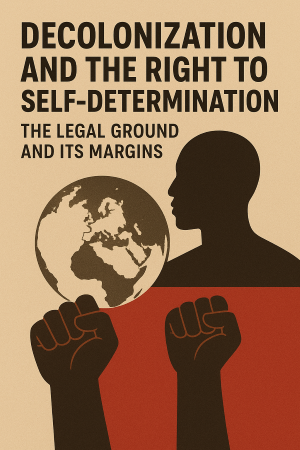
Decolonization and the right to self-determination:  the legal ground and its margins

Decolonization and the right to self-determination: the legal ground and its margins

The ideas about self-determination evolved from the Wilsonian understanding of self-governance - to a norm and drive for decolonization that changed the 20th century’s landscape. Despite its general proclamation as a right to all, the UN applied it as a “principle of saltwater”. Hence, the only legitimate right holder – colonial peoples could realize self-determination under several legal instruments and within the principle of uti possidetis juris that preserved the artificiality of the borders. The legal controversies of the decolonization processes are numerous and its loose end appears to be present up to now since the same principles were applied during the dissolution of the socialistic federations after the fall of the Iron Curtain.

Politics
THE POSSIBILITIES AND LIMITS OF NON-TERRITORIAL AUTONOMY IN SECURING  INDIGENOUS SELF-DETERMINATION

THE POSSIBILITIES AND LIMITS OF NON-TERRITORIAL AUTONOMY IN SECURING INDIGENOUS SELF-DETERMINATION

ABSTRACT non-territorial autonomy (NTA) incorporates a mixture of different arrangements such as consociationalism and national-cultural autonomy (NCA), and forms of representation that de-territorialize self-determination. The paper analyses NTA possibilities in reaching indigenous self-governance and reveals the dilemmas in the applicability of NTA for securing the right to self-determination of indigenous peoples. Although the practice points towards some positive examples and successes of NTA institutions related to ingenious peoples (e.g. Sámi Parliaments), the question remains whether NTA holds sufficient potential for addressing indigenous needs upheld by the international principle “right to land, territories and traditionally owned resources.”

Politics
Legal Arrangements of Artificial Intelligence in the European Union and the Republic of North Macedonia

Legal Arrangements of Artificial Intelligence in the European Union and the Republic of North Macedonia

The article aims to analyze the need to regulate AI, the content of the regulation that needs to be enacted, the content of the regulation adopted in the European Union as well as North Macedonia's positioning on this issue as a country eager to start the negotiations for accession in the EU. The methodology for the article is about the legal arrangements of AI that involve a multi-faceted approach, combining literature review, legal analysis, doctrinal research, empirical research, policy analysis, ethical and normative analysis, and interdisciplinary collaboration. While the rapid development of AI brings convenience to people’s lives, it also poses challenges to global changes and the development of human society, social governance, and legal regulation. Many countries have adopted strategic plans and documents related to AI but there are no legal acts adopted until now. The article's discussion on the need for new or updated regulatory frameworks to govern AI is crucial. It may propose specific regulatory measures to address AI's unique challenges, such as transparency, accountability, and fairness, influencing related policy development

Economy
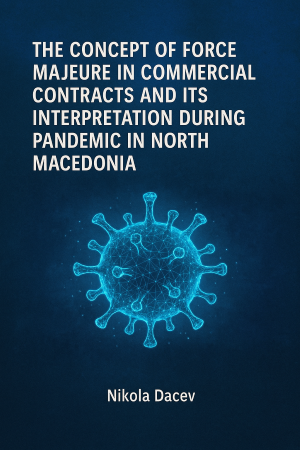
THE CONCEPT OF FORCE MAJEURE IN COMMERCIAL  CONTRACTS AND ITS INTERPRETATION DURING  PANDEMIC IN NORTH MACEDONIA

THE CONCEPT OF FORCE MAJEURE IN COMMERCIAL CONTRACTS AND ITS INTERPRETATION DURING PANDEMIC IN NORTH MACEDONIA

 A pandemic, defined as an epidemic spread over larger regions, is of course not unknown in the world. There are several pandemics in history that have left a great impact on humanity. However, so far there has not been a pandemic of such proportions and consequences as the Covid-19 pandemic. It literally paralyzed life and led to unprecedented health, economic and political consequences on a global scale. As has been the case in every area, Covid-19 has also had a serious impact on legal systems. Many countries were not ready with appropriate legislation to deal with the pandemic in terms of implementing appropriate measures to help their citizens. Because of that, a large number of trade agreements were not realized or their realization was made difficult. What was a serious problem in trade agreements that could not be realized and what is the subject of primary analysis in this paper is the concept of force majeure (vis major), its regulation and the question of whether the pandemic can be considered as a force majeure event. Uncertainty in the interpretation of outdated provisions or lack of appropriate provisions regulating force majeure in pandemic conditions has led to many citizens not being able to exercise their rights derived from contracts and thereby creating dysfunctionality in legal systems. In this paper, it is essential to review the force majeure clause, its concept, development and representation in different legal systems, by making a brief comparison between French law and English law and determining key regulations on an international level. At the same time, the main focus of research will be on the regulations in North Macedonia and the manner of regulating this concept of force majeure. It is also equally important to find the answer to the question of the role of legal systems, whether law as such will continue to exist in the same form and with the same content or whether we already are in the phase of creating the so-called pandemic law, i.e., whether the pandemic initiates a rearrangement of the concept of force majeure in trade agreements in North Macedonia, as well as everywhere in the world.

Economy
The Role of Leaders in Shaping Organizational Culture and Ethics

The Role of Leaders in Shaping Organizational Culture and Ethics

Within the bricks and mortar economy, organizations focused more on profitability and require managers who can design and implement strategies over time. Nowadays, within the digital economy, e-business-oriented organizations focus on competitiveness and customer satisfaction, requiring astute leaders. Leaders who rely on intellectual or knowledge resources to initiate and implement a new set of company aims based on e-business initiatives. Leaders who can develop organizational cultures, ethics, and teams that can realize the potential of cutting-edge technology (the Internet of Things, Artificial Intelligence) for their business. Investing in technology is important, but the critical success factor is getting people to use it effectively. Not every manager is a leader. Managers, as good leaders, should link competencies and resources within the organization to create and sustain a competitive advantage. Incumbent managers as leaders must maximize the e-space available within the organization by developing strategies for shaping culture and ethics that can operate effectively in the new environment. In this direction, the main goal of the paper is through surveying, descriptive analyses and by using practical case studies, to demonstrate leaders’ role in cultivating culture and ethics within the organization. Moreover, the paper elaborates how, thanks to skillful leaders, famous and successful organizations try to create organizational culture and ethics that are aligned with their goals for success

News

Politics
12-day Israel-Iran war

12-day Israel-Iran war opened Pandora's box: What comes next?

Though seemingly concluded by a Trump-brokered cease-fire, the 12-day Iran-Israel war has likely opened the door to a prolonged...

Society
Global implications of the U.S. attack on Iran

Global implications of the U.S. attack on Iran

Despite growing claims of a multipolar world, the U.S. remains the sole hegemon as Europe bandwagons, Russia remains indifferent, an...

Politics
Israel's violation of international law

Israel's violation of international law: Attack on aid ship Madleen

The seizure of a humanitarian aid ship carrying civilians exposes not only Israel's ongoing blockade of Gaza, but also its...

Society
Regional security challenges

Regional Security Challenges in the Western Balkans

An analysis of emerging security threats and the role of international cooperation in maintaining stability across the region...

Economy
Economic diplomacy

Economic Diplomacy and Trade Relations in Southeast Europe

Examining the intersection of economic policy and diplomatic relations, and how trade partnerships shape regional politics...

Politics
Democratic institutions

Strengthening Democratic Institutions in Post-Conflict Societies

The challenges and opportunities for building robust democratic frameworks in societies transitioning from conflict to peace...

Document